Superfantastica
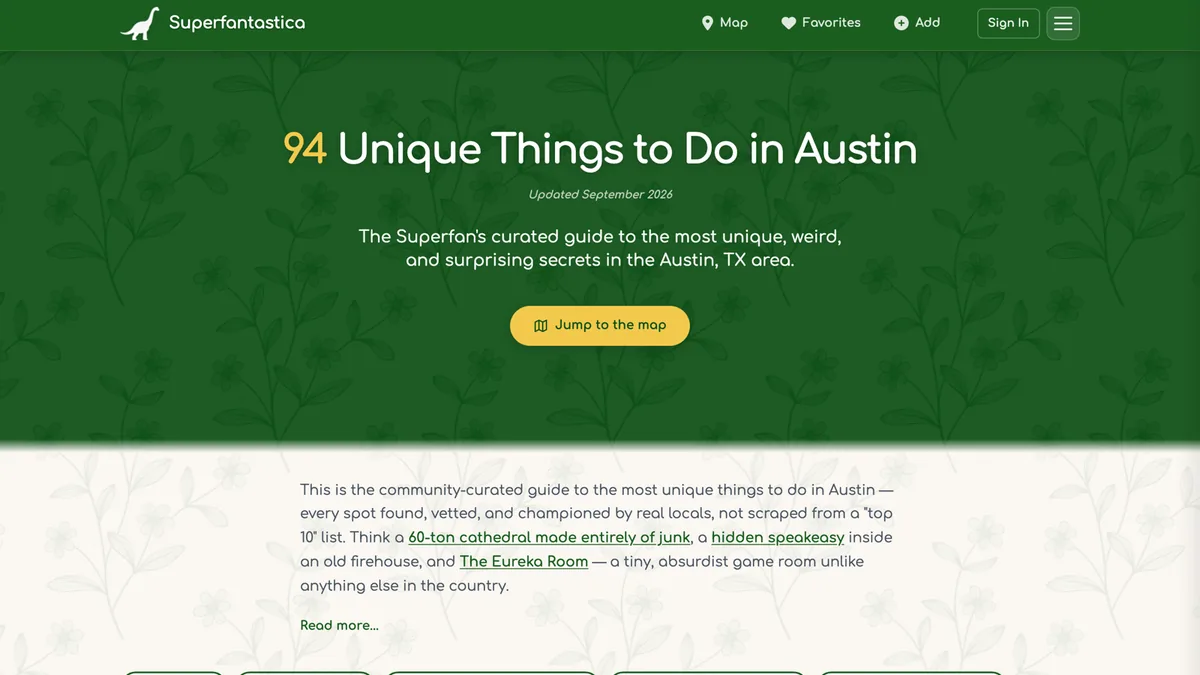
Austin, Texas is full of genuinely weird and wonderful places — a backyard cathedral made from 60 tons of junk, a giant metal octopus wrapped around a building, a bar decorated for Christmas 365 days a year. But finding these places meant sifting through ad-heavy listicles, outdated blog posts, or asking the right local at the right time.
We built a guide to unique things to do in Austin that was free, fast, ad-free, and actually useful — something that could scale to hundreds of listings across multiple cities without requiring a full editorial team.
The question: Could AI handle the heavy lifting of research and content creation while keeping quality high enough that real humans would trust it?
AI-Powered Content Pipeline
The core innovation was a multi-stage AI pipeline that transforms a simple venue name and URL into a rich, publication-ready listing:
Automated Research
The system scrapes venue websites, pulls data from multiple search APIs, and compiles comprehensive research briefs on each location.
Fact Extraction
A specialized AI model extracts structured data — address, phone, hours, social media, accessibility info — from raw web content, cross-referencing multiple sources for accuracy.
Content Generation
Using the research brief as source material, AI generates engaging descriptions that capture what makes each place special — not just the facts, but the experience.
Photo Intelligence
When photos are uploaded, AI automatically generates alt text for accessibility, detects the main subject, and calculates optimal focal points so images crop beautifully across every screen size.
Quality Control
Every AI-generated listing goes through a human review pipeline before publication. AI handles the 80% that's tedious; humans handle the 20% that requires judgment.
Admin & Triage System
We built a custom admin application that manages the full lifecycle of each listing:
Triage Queue
Evaluates new submissions and routes them into the processing pipeline automatically.
Pipeline Tracking
Multi-stage tracking through research, facts, content, photos, and GPS verification — with bulk processing tools for handling dozens of listings at once.
Photo Management
Automatic optimization and CDN delivery. Community moderation tools for reviewing user-submitted photos and content.
Community-Driven Architecture
The platform wasn't designed to be a one-person operation. Community members (“Superfans”) contribute directly:
- Submit new places with photos and GPS coordinates from their phones
- Add photos to existing listings by swiping on any card
- Review and vote on listings in an “intel queue”
- Earn achievements for contributions
Performance-First Architecture
The public site is a static-first build deployed to Cloudflare's edge network:
Sub-Second Page Loads
Pages are pre-built at deploy time, served from the nearest edge node worldwide.
Zero Egress Costs
Originals stored in Supabase, automatically converted to WebP at multiple sizes, served from Cloudflare R2.
Self-Hosted Vector Maps
Built with MapLibre GL and PMTiles for fast, interactive maps with no per-request API costs.
AI as a Force Multiplier
Superfantastica demonstrates what's possible when AI is used as a force multiplier rather than a replacement. The AI handles research, data extraction, image processing, and first-draft content. Humans provide curation, quality control, and the judgment calls that make the difference between a generic listing and one that makes someone want to get in their car and go.
This is the approach we bring to every M41 Strategies engagement: identify the parts of your workflow where AI can save the most time, build custom tools around those opportunities, and keep humans in the loop where they matter most.