Show, Don't Propose
The prospect: a company that sells specialized electronic measurement instruments — modular hardware plus companion software — to government agencies, labs, and universities. Their online store needed a rebuild, and they were deciding whether to work with us.
The traditional consulting move is a proposal deck describing what we would build. AI makes a stronger move affordable: build it. We delivered five complete, clickable design directions in the browser, populated with all 25 of their real products, real descriptions, and real images.
The question: When mockups cost a session instead of a sprint, why would a pitch ever be static slides?
Not Screenshots — Working Pages
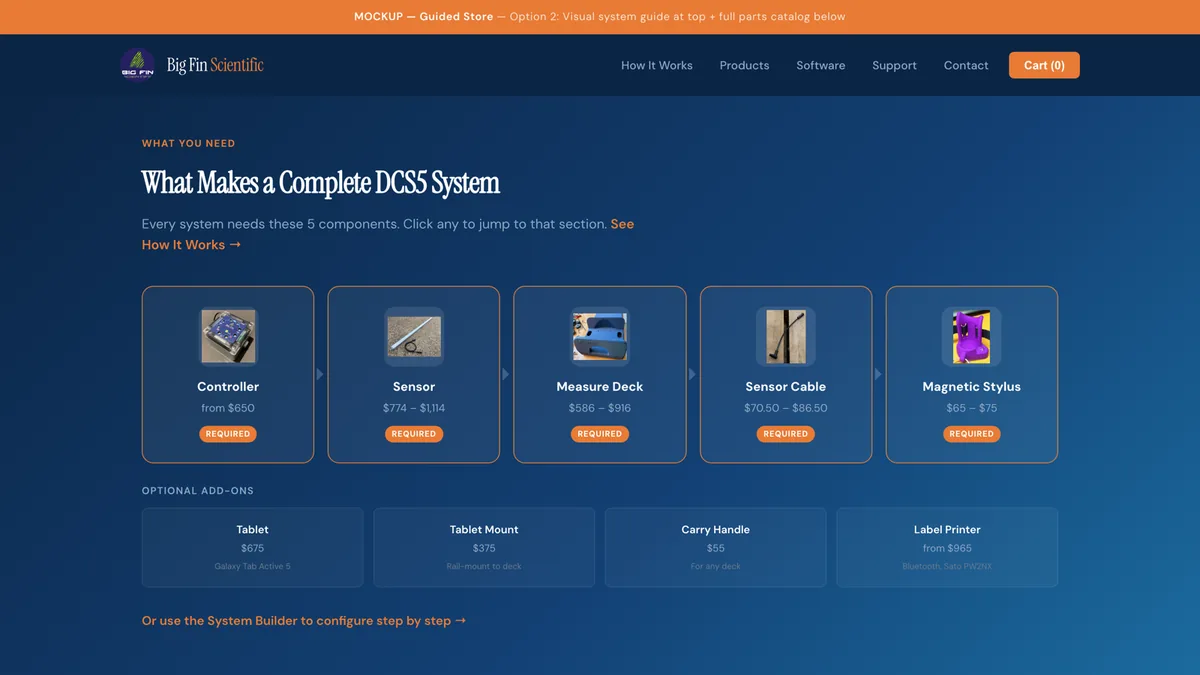
Four Store Directions
Four distinct takes on the store — from a parts-only catalog to a fully guided shopping experience — each a complete page with category filters, compatibility tags, and quote-request flows, all switchable from one wrapper for side-by-side comparison.
An Interactive System Builder
Their hardware is modular, so we built a step-by-step configurator: pick a controller, sensor, cables, and accessories, with a live price total updating as you click. A prospect's product logic, working in the browser, before any contract.
A Product Explainer
A long-form “how it works” page translating a technical product line into a guided narrative — the kind of page that shortens sales cycles for complex hardware.
A Bonus: AI Product Photography
A side demo showing their plain phone photos transformed into polished product imagery with AI — a preview of what modern content operations could do for their catalog.
Real Data Makes Mockups Land
Generic lorem-ipsum mockups make prospects do imagination work. These didn't: AI collected the company's full product catalog from their existing site — names, descriptions, prices, images — so every mockup showed their business, better. The configurator used their actual component prices for its live totals.
Everything shipped as plain, dependency-free web pages. No staging server, no framework, no login — a folder of files anyone at the company could open and click through.
The Prototype Is the New Proposal
When working software costs hours, the gap between “here's what we'd do” and “here's what we did” disappears. Prospects don't have to trust a description; they click the thing. That's true for pitches, internal buy-in, investor demos, and every other moment where an idea needs to survive contact with a skeptic.