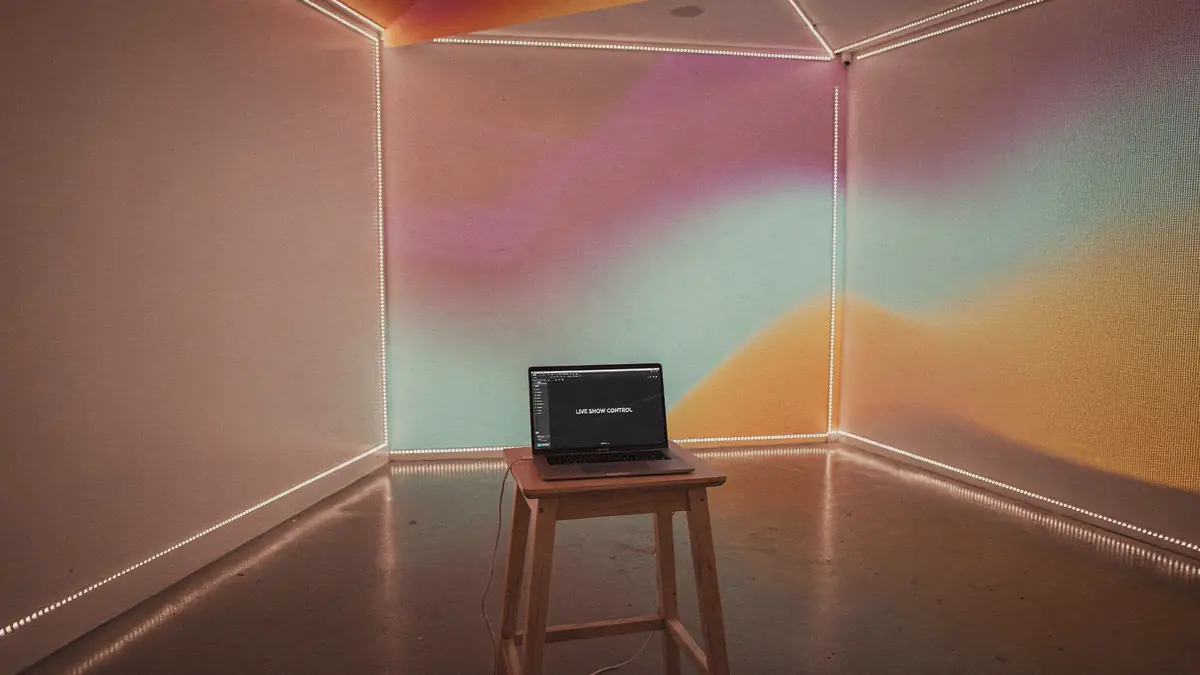
The Eureka Room's Show Pipeline
The Eureka Room is an immersive venue in Austin: two 12-foot LED walls and a projected front wall wrap around a group as one continuous image, synchronized with sound and light. For years the room ran on TouchDesigner, the industry-standard visual programming tool for shows like this.
The problem wasn't that TouchDesigner couldn't do the job. It's that building anything new in it took hours of clicking through a node graph — while AI can write a working web page in thirty seconds. The tool had become the bottleneck on new experiences, and automating around it was risky enough that one bridge tool nearly destroyed the show file.
The question: Could a custom engine replace a mature industry tool outright — and make new experiences something you build in an evening instead of a week?
Extract, Don't Rebuild
Rescue the Hard-Won Work
Years of LED pixel-mapping and projector calibration lived inside TouchDesigner. Instead of redoing it, we extracted the mapping — per-LED coordinates for all 21,000 pixels — and validated the new output byte-for-byte against the old system's.
Build the Engine
A single custom program now renders a 4K canvas at 60fps and drives everything: both LED walls, the keystone-corrected projector, and a positional audio mixer. The full replacement engine was written — with AI — in two days.
Make Experiences Cheap to Create
Each show is now a small hot-loadable file: edit, save, and see it in the room half a second later. The scene API is documented as a contract for AI-written experiences — 20 scenes exist already, plus a library of 25 live-tunable shader effects.
Add What the Old Tool Never Could
Camera-based body tracking with a 13-millisecond reflex loop, and a voice-interactive AI character that hears guests, answers in character, and fires room effects — about 2.5 seconds from speech to a talking, reacting room.
Content Velocity Is the Moat
The rebuild wasn't about replacing software — it was about changing the venue's economics. New experiences used to be an engineering project; now they're an evening of conversation with AI:
- A new group experience built in one evening — competitors staff in-house teams and brag about one-week builds
- A tabletop-gaming night prototyped in two days: a game master runs the whole room from a tablet — scenes, character art, music, sound effects — a potential new bookable product
- Live experiments during sessions: the room can be edited while it runs, safely — a broken edit keeps the previous version playing
AI Changes the Build-vs-Buy Math
The old advice was “never build what you can buy.” That advice assumed custom software takes months. When a full replacement for a specialized industry tool takes two days to write and a week to put into production, the calculation flips for any business whose off-the-shelf tool has become the bottleneck.
The same pattern — keep the hard-won data, replace the tool around it — applies to CRMs, booking platforms, schedulers, and every other system a business has outgrown. This venue also replaced its booking platform the same way.